Strategy
Media planning: turn a channel list into a placement worksheet
Build a practical media plan with one audience, a clear job for each placement, creative requirements, delivery checks and a decision-ready review.
Vladlens Kecko · · 4 min read
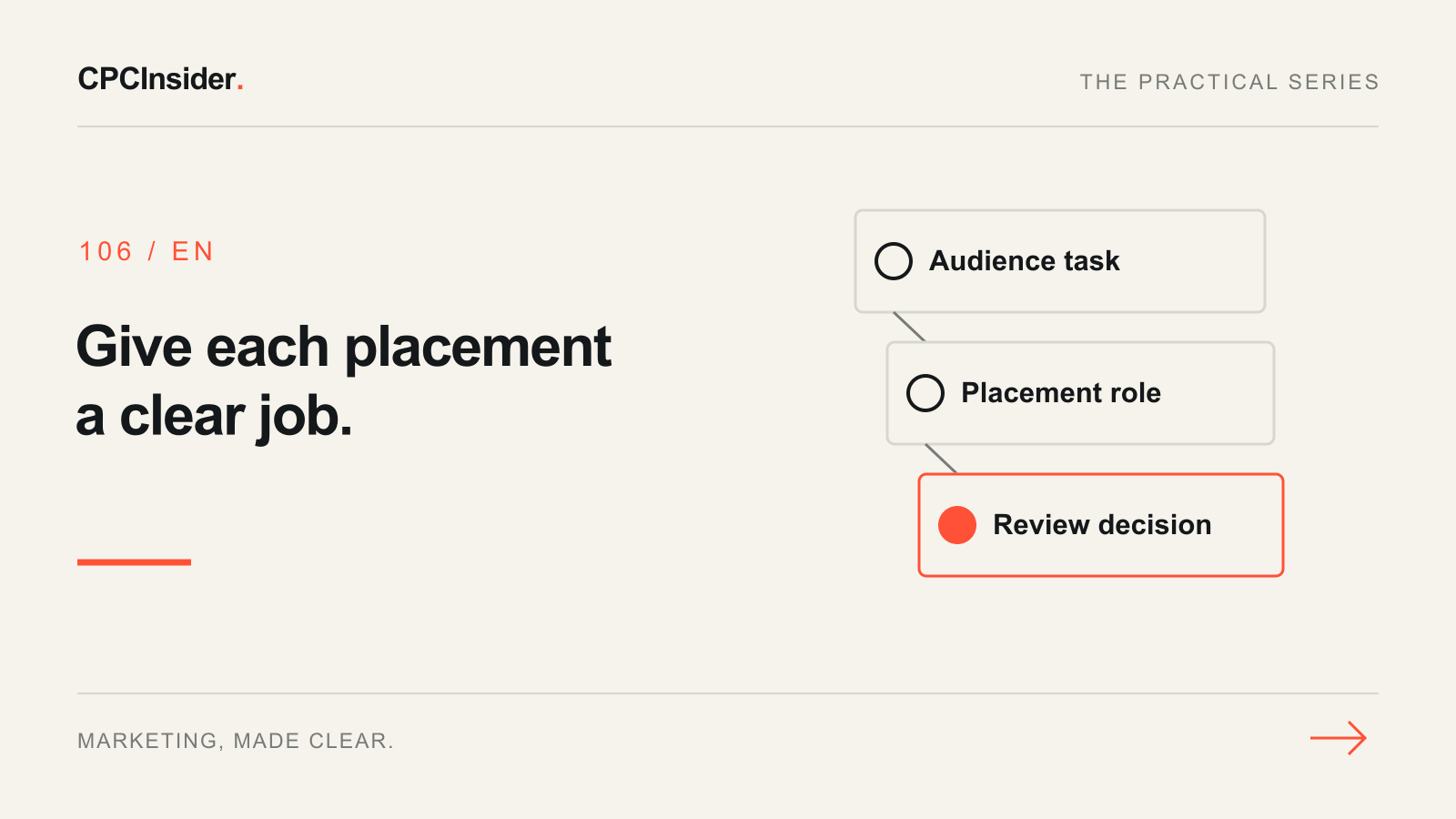
Your media plan lists Google, social and email. But nobody can explain what each placement should do, which asset it needs or when to stop it. Start by opening the plan and adding a customer task beside every planned placement. If two rows perform the same job, explain why both belong before dividing the budget.
Media planning connects audience, message, placement, timing and measurement. A budget answers what you can fund; this worksheet answers what will actually run and why. Keep the budget worksheet beside it rather than replacing it.
Start with one objective and a real audience
Write the business action you want, its owner and the period you will review. Then describe the buying situation: what the customer is trying to solve, what they need to believe and where you have evidence they seek information. Use recent customer conversations, site searches and actual enquiry sources. Separate that evidence from a channel you simply want to try.
BDC’s channel research is a useful reminder to examine discovery and decision journeys together. Its Canadian findings are context, not a channel ranking for your own market. Validate your audience before copying anyone’s media mix.
Give each placement one row
Copy this blank structure into a shared sheet. Record the actual placement or format, not just the platform name.
| Field | What the owner writes |
|---|---|
| Customer task | The question or action this placement supports |
| Audience evidence | Where the audience insight came from and when |
| Placement and destination | Format, market, language and exact landing page |
| Creative requirement | Asset, dimensions, message and approval owner |
| Delivery constraint | Dates, authorised spend, stock or sales capacity |
| Review rule | Metric definition, data source, review date and next decision |
For awareness, define relevant exposure and how you will assess it. For lead generation, define an accepted enquiry and who will follow it up. Do not ask a single short placement to prove every stage of a long buying journey.
Check delivery before booking or launch
Open the destination on mobile. Check that its language, offer and next step match the asset. Confirm creative specifications with the actual publisher or platform. Ask who can approve changes and who can pause delivery if the destination fails.
Tools such as Google Reach Planner, where available, can support planning. Keep their estimates labelled as estimates. Do not add reach estimates from different platforms as if they represented different people: audiences can overlap.
Use the measurement-plan guide to document events and outcomes before launch. A planned placement without a working destination or a measurement owner is not ready for funding.
Review the weakest assumption first
At the agreed review, distinguish a delivery problem from an audience or message problem. If the placement never delivered as planned, investigate delivery first. If it reached the intended audience but the next action is weak, inspect the promise and destination before adding another channel. When records are incomplete or the buying cycle is unfinished, record what remains unknown.
Final check: every row has an audience reason, one job, an approved asset, a working destination, an owner and a review decision. Keep changes tied to evidence rather than filling a calendar with more placements.
Set the review date around the decision you can actually observe. Write the stop condition in advance, including who can pause a placement if the destination breaks; a review date alone is not a decision rule.
Put your media plan through a growth review
Bring the worksheet to a free 30-minute founder-led growth review. We will identify the main gaps and follow up with a short written three-priority action plan. There is no obligation to hire CPCInsider; implementation is agreed separately.
About the author
Free founder-led growth review
Know where to focus your next marketing investment.
In a focused 30-minute conversation, we review your advertising, website and sales follow-up together. Afterwards, you receive a short written action plan you can use with your own team or with ours.
Your biggest growth gaps
See where your ads, website or follow-up may be losing potential customers.
Your next 3 priorities
Get a ranked action list with the reason for each recommendation and what to check next.
A practical starting plan
Leave with clear next steps for your team, plus our recommendation if you want help implementing them.
Continue reading
Marketing mix: a 4Ps worksheet before you increase ad spend
Use the 4Ps to align your offer, price, buying route and promotion. Includes a service-business example and a practical decision worksheet.
Small-business marketing budget: a monthly template and example
Build a small-business marketing budget with a worked €3,000 example. Track commitments, forecast overspend and decide what to fund next without guesswork.
Advertising measurement: build a GA4 and CRM measurement plan
Build a GA4 measurement plan with event definitions, Google Ads goals and CRM outcomes. Use a practical worksheet and pre-launch checks.