Strategy
What is market research? Start with a five-interview decision worksheet
Plan five focused customer interviews around one business decision. Includes neutral prompts, an evidence table and clear limits on small-sample conclusions.
Vladlens Kecko · · 6 min read
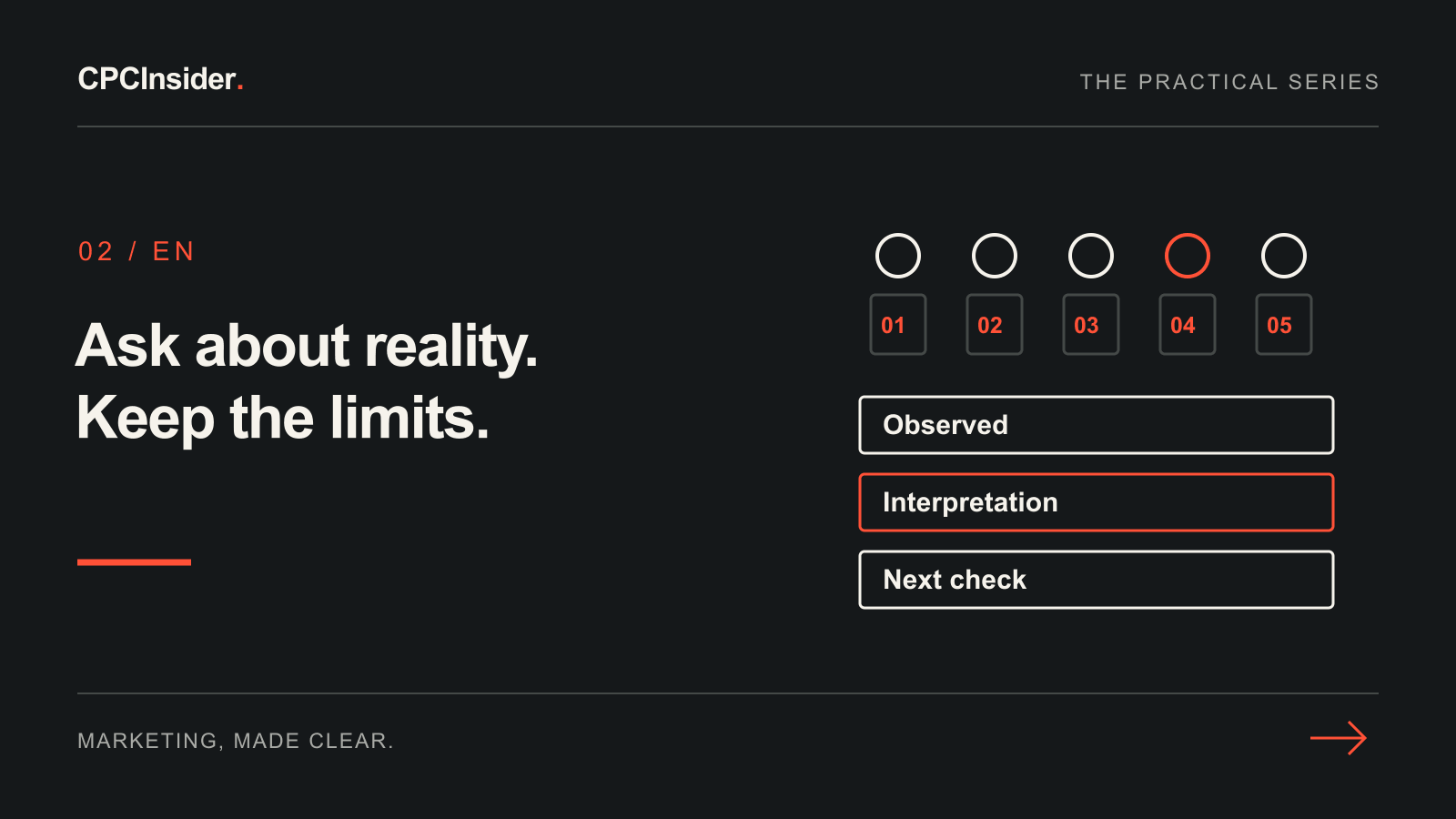
Market research is the work of gathering and assessing evidence about customers and the market to inform a decision. It can include existing data and direct research. A customer interview is one method, not a substitute for measuring market size or estimating search demand.
If the team is debating an offer without understanding how buyers choose, a small interview round can identify questions worth testing. GOV.UK's in-depth interview guidance recommends exploring real examples with open, neutral questions. Our worksheet applies that approach to one commercial decision; five interviews are a manageable starting project, not a universal sufficient sample.
1. Write the decision before the discussion guide
For a fictional commercial-cleaning provider, the decision might be: should its proposal explain the supervision and handoff process more clearly before the team changes the price? The research question is what buyers needed to trust the service during their most recent selection.
Do not start with “Do customers like our new package?” That invites a reaction to your idea rather than evidence about the buying process. Choose the customer group with the segmentation worksheet and record what evidence could change your current view.
2. Create a recruitment matrix
Plan to speak with people who have relevant recent experience. A possible five-person round could include two recent buyers, two prospects who chose another route and one person who postponed the decision. Those numbers are a proposed learning mix, not a representative sample.
Record role, buying situation, approximate decision timing and why the experience is relevant. Include a note about who is missing. Five enthusiastic existing customers alone may tell you little about the reasons suitable prospects did not buy.
Ask for permission to take notes or record, explain the purpose and keep identifiable records access-controlled. Participation does not imply permission to publish a quote or use the conversation as a testimonial.
3. Use a short guide that follows the last real decision
| Prompt | What to look for |
|---|---|
| What first made you look for a provider? | Trigger and situation |
| What did you do next? | Actual sequence and alternatives |
| What information was difficult to obtain? | An evidence or process gap |
| Who else had to agree? | Decision roles and approvals |
| What happened after you chose or postponed? | Outcome and unresolved work |
Use follow-up questions to clarify a specific incident. Do not turn “What was missing?” into “Would our new dashboard solve that?” Keep a separate space for your interpretation so it does not become part of the participant's account.
4. Build an evidence table, not a persuasive story
After each conversation, write the participant code, observed issue, supporting example, uncertainty and possible implication. Record contradictory accounts rather than removing them to simplify the presentation.
In a fictional summary, three of five participants could describe uncertainty about who supervised cleaning, one could emphasise access arrangements and one could focus on price. This means three people in this particular round mentioned supervision. It does not establish that 60% of the market prioritises it or that a new supervision message will increase sales.
| Observation | Interpretation to check | Next evidence |
|---|---|---|
| Three accounts mention an unclear supervisor | The handoff explanation may be incomplete | Inspect proposals and service process |
| One buyer chose mainly on price | Different purchasing criteria may exist | Check context and segment differences |
| One postponed the decision | Non-purchase may be an alternative | Investigate timing and internal approval |
5. Choose one reversible next step
If the process really includes a supervisor, draft a clearer explanation for review by the delivery owner. If no such process exists, a marketing claim cannot fix the operational gap. Use the positioning statement worksheet to check claims against facts.
Define what you will observe next: whether suitable readers understand the handoff, whether clarification questions change and what subsequent proposals record. Keep audience, dates and other changes visible. Comprehension or enquiry counts alone do not establish causal sales lift.
Your output: a decision memo
Summarise the decision, recruitment gaps, evidence, contradictions and one next test. For public competitor evidence, use the separate competitor-analysis worksheet. Request a free 30-minute founder-led growth review for a short written three-priority plan with no obligation to hire CPCInsider.
About the author
Free founder-led growth review
Know where to focus your next marketing investment.
In a focused 30-minute conversation, we review your advertising, website and sales follow-up together. Afterwards, you receive a short written action plan you can use with your own team or with ours.
Your biggest growth gaps
See where your ads, website or follow-up may be losing potential customers.
Your next 3 priorities
Get a ranked action list with the reason for each recommendation and what to check next.
A practical starting plan
Leave with clear next steps for your team, plus our recommendation if you want help implementing them.
Continue reading
Positioning statement: write a claim your sales team can prove
Define the buyer, buying situation, alternative and credible difference. Build an internal positioning statement with a proof table and a fictional example.
Market segmentation: choose a customer group your team can actually serve
Compare customer groups by their needs, buying situation and delivery fit. Includes a fictional B2B example and a practical segment-selection worksheet.
Competitor analysis: turn public evidence into one useful marketing test
Compare customer alternatives using dated public evidence. Separate facts from assumptions, then choose one useful offer or customer-journey test.