Paid Media
Cost per mille: compare CPM offers without comparing different impressions
Compare CPM offers using the same cost basis, impression definition, currency and delivery window, then check quality and business outcomes separately.
Vladlens Kecko · · 4 min read
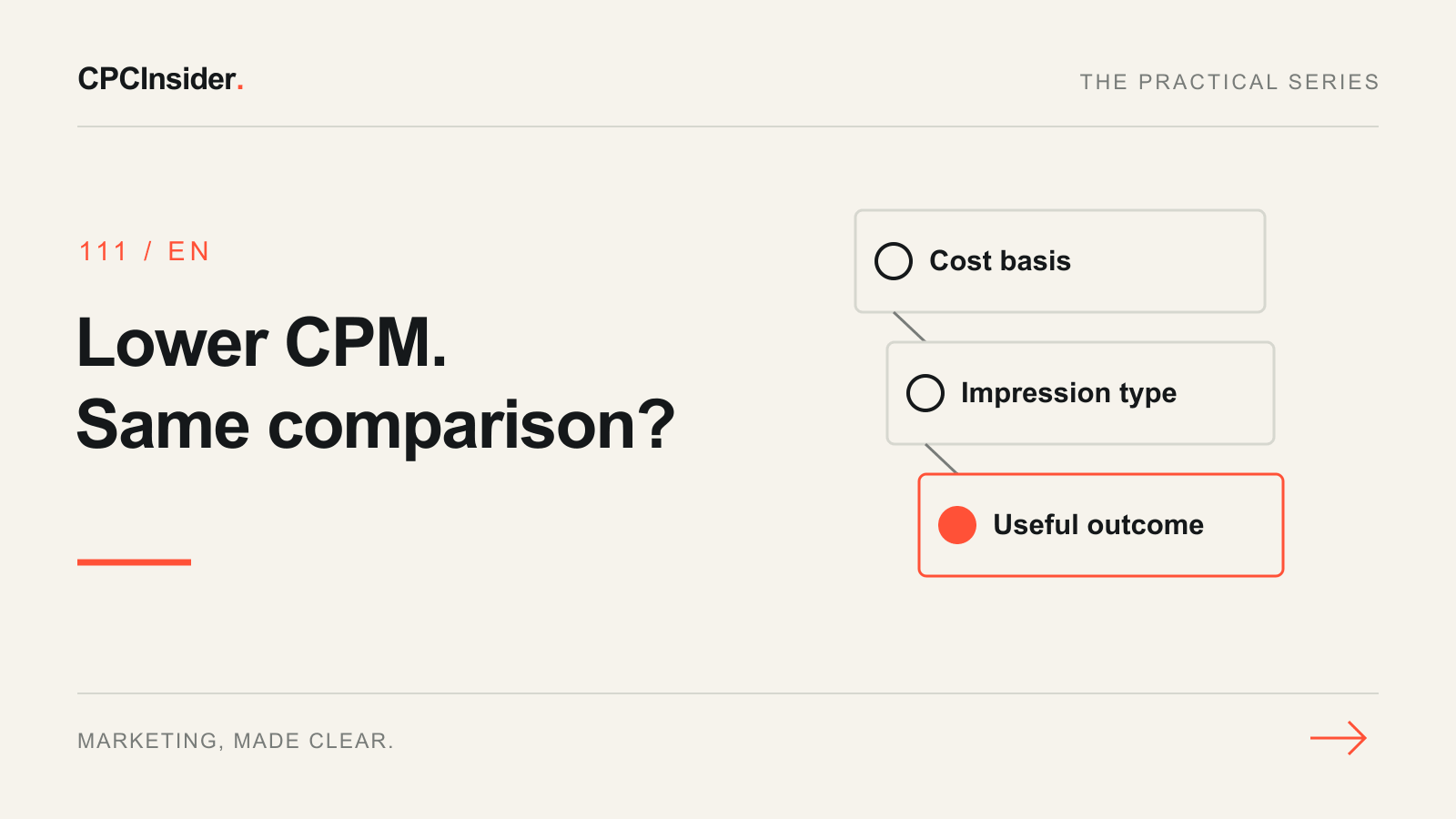
One placement has a lower CPM. Before calling it the better buy, ask which costs and which impressions are included. A media-only quote and an all-in campaign cost are different numerators. Delivered impressions and viewable impressions are different denominators.
Cost per mille means cost per thousand impressions. Calculate it as cost ÷ impressions × 1,000. Amazon Ads’ CPM guide explains the metric in advertising. CPM describes a price relationship; it does not tell you whether the audience was suitable or bought anything.
Build one comparable cost basis
Write down what each quote or report includes: media, platform fees, agency fees, production, verification and tax treatment where applicable. Choose either a media-only or an explicitly defined all-in comparison. Keep excluded costs visible rather than assuming a lower figure includes them.
Use the same currency and a documented conversion method where needed. Match actual spend to actual delivered impressions from the same window. Keep planned prices and forecasts separate from observed delivery.
For combined rows, divide total compatible cost by total compatible impressions and multiply by 1,000. Do not average row-level CPMs without impression weighting. When impressions are zero, CPM is unavailable; the formula cannot yield a meaningful rate.
Check what the impression means
Ask the seller or platform which impression is counted and how it is measured. A reported CPM can be a calculated metric even when the campaign is billed by another method. It is not necessarily a statement of the billing model.
Google’s CPM guidance distinguishes its viewable-impression bidding context. With vCPM, the viewability basis matters. Active View documentation helps interpret Google’s measurement. A viewable impression is not proof that a person paid attention, remembered the message or took action.
Use this comparison sheet
| Field | Check before comparing |
|---|---|
| Cost | Same inclusions, currency and tax basis |
| Impression | Same delivered or viewable definition |
| Audience | Market, language, targeting and relevance |
| Format and environment | Placement, device and creative requirements |
| Delivery window | Same period or clearly labelled timing difference |
| Quality evidence | Available verification, measurement limits and exclusions |
| Outcome | Defined next action and a working destination |
Do not merge unlike denominators just to produce one ranking. If the seller cannot explain an important field, record the comparison as incomplete and ask for the missing definition.
Diagnose the cheaper option before scaling
If CPM falls while the audience or placement mix changes, inspect that change first. If delivery looks comparable but useful visits or enquiries weaken, check the creative promise and landing page. If the goal is awareness, use a defined brand-awareness measurement plan rather than requiring immediate sales to stand in for every effect.
Keep frequency and reach visible where they are available, but do not add reach across platforms as if audiences never overlap. More cheap impressions can mean repeated delivery to the same people. Review the proposed placement’s role in the media planning worksheet before expanding it.
Final check: comparable cost, compatible impressions, suitable audience, clear measurement limits and a relevant outcome. A lower CPM can improve a plan’s economics; it does not establish a better campaign on its own.
If you also compare a viewability rate, ask which measured impressions form its denominator. Do not substitute that denominator into CPM or assume unmeasurable impressions were viewable.
Review the media comparison
Bring the sheet to a free 30-minute founder-led growth review. We will identify the main customer-journey and measurement gaps, then send a short written three-priority plan. There is no obligation to hire CPCInsider; implementation is agreed separately.
About the author
Free founder-led growth review
Is your advertising budget turning into customers?
In a focused 30-minute conversation, we review your advertising, website and sales follow-up together. Afterwards, you receive a short written action plan you can use with your own team or with ours.
Your biggest growth gaps
See where your ads, website or follow-up may be losing potential customers.
Your next 3 priorities
Get a ranked action list with the reason for each recommendation and what to check next.
A practical starting plan
Leave with clear next steps for your team, plus our recommendation if you want help implementing them.
Continue reading
LinkedIn Ads: plan one B2B lead generation pilot
Plan a focused LinkedIn Ads test with one audience and offer. Check Lead Gen Form delivery and judge results using accepted opportunities.
Media planning: turn a channel list into a placement worksheet
Build a practical media plan with one audience, a clear job for each placement, creative requirements, delivery checks and a decision-ready review.
Brand awareness: build a measurement plan beyond impressions
Separate exposure, recognition and demand signals. Build an awareness measurement sheet without treating reach, direct traffic or branded searches as proof of lift.