Strategy
SWOT analysis for marketing: turn four boxes into one decision
Separate internal strengths and weaknesses from external opportunities and threats. Use an evidence-led example to choose one practical marketing action.
Vladlens Kecko · · 6 min read
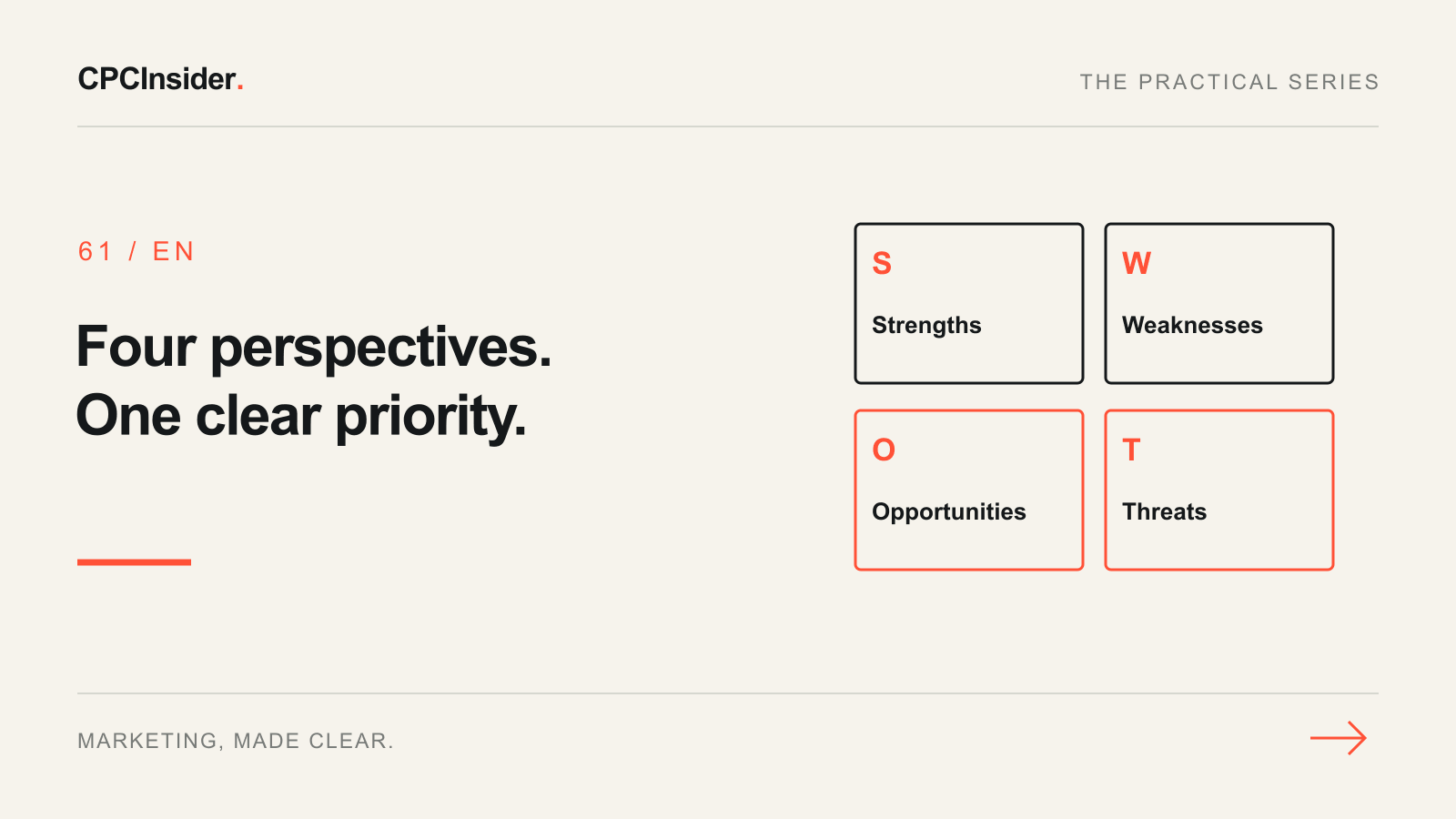
A SWOT analysis sorts strengths, weaknesses, opportunities and threats around a defined decision. Strengths and weaknesses concern the organisation; opportunities and threats concern its external environment. The British Columbia marketing guide explains that internal/external distinction. A four-box list becomes useful when it changes a choice your team must make.
This worksheet focuses on a marketing decision, such as whether to promote a new service agreement. It does not replace customer research, a financial forecast or a 90-day execution plan. Its output is one evidence-backed priority, with an owner and a test.
1. State the decision and its boundary
Write the offer, intended customer group, time horizon and current delivery limits. “Improve our marketing” is too broad. “Decide whether to test a planned-maintenance offer for single-site offices this quarter” creates a clearer scope.
Invite the people who understand enquiries, sales and service delivery. Collect relevant evidence before discussing labels. Keep the dates and the comparison basis: a strength should matter to the customer or the decision, rather than simply be a flattering company description.
2. Separate facts from attractive statements
“Great service” is not useful without evidence. An approved service log showing consistent appointment confirmation is more concrete. “Run more ads” is a proposed action, not an external opportunity. “Competitor” alone is not a threat; explain what observed competitive change could affect this offer.
For each entry record the observation, source, date, relevance and confidence. Mark unverified explanations as assumptions. BDC’s SWOT guide stresses relevant data and translating priorities into actions with responsibility and timing. The decision worksheet below is our practical application.
3. Build a fictional service-business SWOT
Every entry below is invented to demonstrate classification. These are not market findings, competitor claims or CPCInsider client results.
| Category | Fictional observation | Why it matters to the proposed offer |
|---|---|---|
| Strength — internal | The team has an established planned-visit checklist | Could support a clear, repeatable service promise |
| Weakness — internal | New quote requests have no backup owner | More enquiries could increase unanswered work |
| Opportunity — external | Buyers in the scenario are seeking scheduled visits | Could create a relevant buying situation if verified |
| Threat — external | A competing offer in the scenario includes easier booking | Could make the current enquiry process less attractive |
Do not publish the opportunity or competitor statement as a fact about your market. In real work, validate the buying need and the actual offer. An assumed trend should remain an open research item, not evidence for a spending increase.
4. Link a finding to one response
Combine relevant findings into a decision. In the fictional example, existing delivery capability is promising, but missing enquiry ownership blocks a responsible traffic increase. One possible response is to assign a backup owner and clarify the confirmation process before testing the offer.
That is a proposed experiment, not a guaranteed result. Record what would support or contradict the explanation. If enquiries already receive a prompt useful response, the team should investigate another constraint rather than implementing a favourite solution.
| Decision field | What to write |
|---|---|
| Evidence pair | The internal and external findings behind the choice |
| Priority | One constraint or opportunity worth addressing first |
| Action | A deliverable the team can complete |
| Owner and boundary | Responsible person, scope and resource limit |
| Review | Timing, useful outcome and stop/change condition |
| Uncertainty | What is still assumed and how it will be checked |
5. Choose a test the business can absorb
Keep a spending boundary and account for sales and delivery capacity. A first check could examine whether eligible enquiries receive an assigned owner and a confirmed next action. Track counts and exceptions before treating changes in revenue as evidence about the test.
Use the weekly marketing scorecard for the review. A before-and-after result can reflect seasonality, demand, staffing or tracking changes. SWOT organises reasoning; it does not establish market demand or causal advertising lift.
6. Keep SWOT, segmentation and the plan distinct
SWOT asks which internal and external conditions matter to a decision. Market segmentation helps choose the customer group. The marketing brief specifies the deliverable, while the execution plan assigns the work over time. Use the appropriate next tool instead of producing several documents with the same generic bullet points.
Before closing the review, remove unsupported claims, assign each open question and agree when the decision will be revisited. Update the evidence when conditions change; do not merely refresh the document date.
Choose a practical next priority
Bring the decision, the evidence and one unresolved constraint. Explore strategy support or request a free 30-minute founder-led growth review. Receive a short written plan with three priorities, with no obligation to hire CPCInsider.
About the author
Free founder-led growth review
Know where to focus your next marketing investment.
In a focused 30-minute conversation, we review your advertising, website and sales follow-up together. Afterwards, you receive a short written action plan you can use with your own team or with ours.
Your biggest growth gaps
See where your ads, website or follow-up may be losing potential customers.
Your next 3 priorities
Get a ranked action list with the reason for each recommendation and what to check next.
A practical starting plan
Leave with clear next steps for your team, plus our recommendation if you want help implementing them.
Continue reading
Marketing plan: a 90-day template your team can use
Build a marketing plan with a free template, a worked example and clear budget decisions. Set priorities, assign owners and measure progress over 90 days.
Market segmentation: choose a customer group your team can actually serve
Compare customer groups by their needs, buying situation and delivery fit. Includes a fictional B2B example and a practical segment-selection worksheet.
How to build a weekly marketing scorecard for your team
Create a weekly marketing report with defined KPIs, owners and next actions. Use lead-generation and ecommerce examples to turn numbers into decisions.