Growth Strategy
Objection handling in sales: find the question before writing the answer
Separate price, timing, fit and uncertainty before responding to a sales objection. Use a question-and-evidence worksheet without pressure scripts.
Vladlens Kecko · · 4 min read
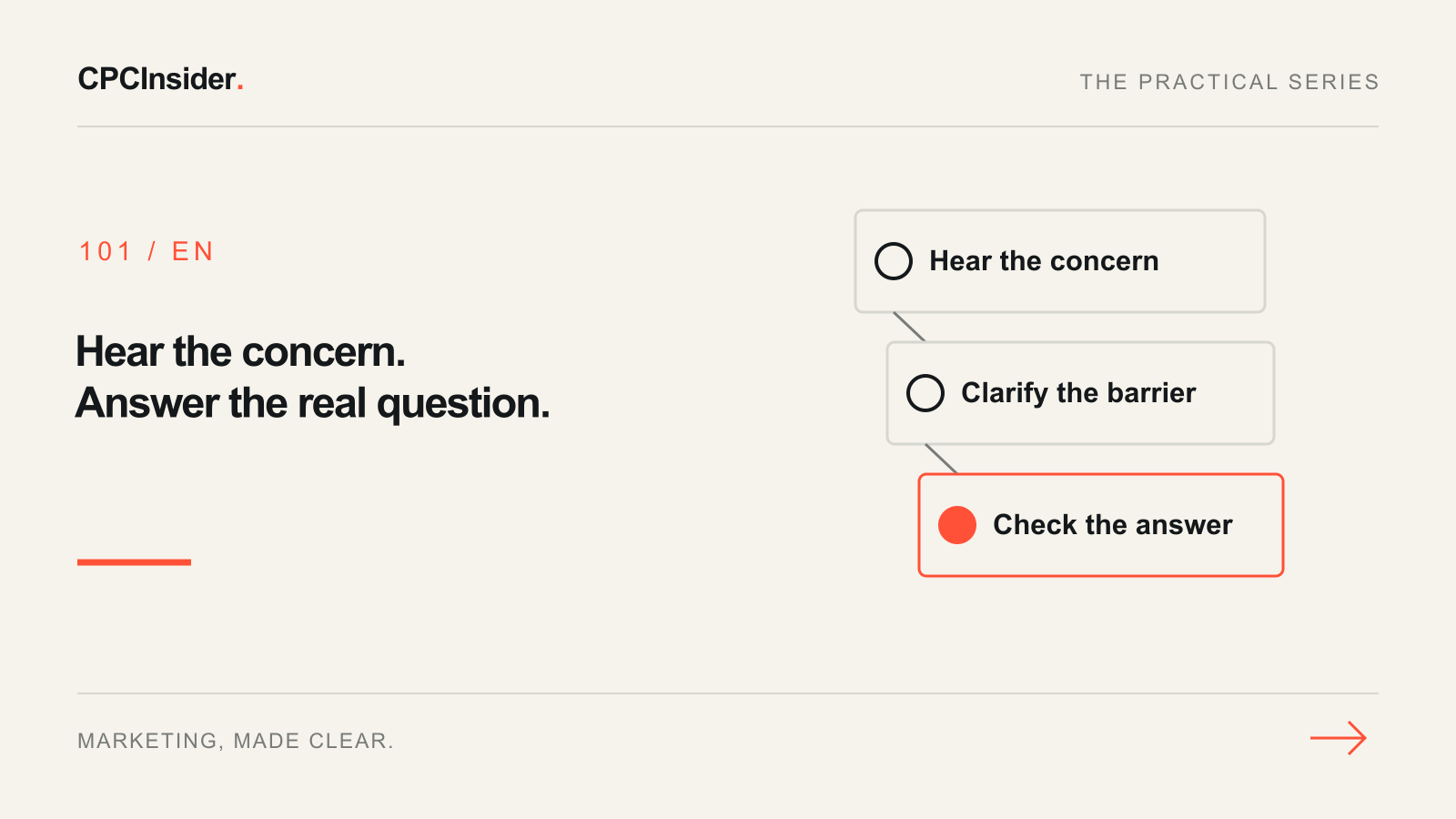
The buyer says it is too expensive, and the team immediately offers a discount. First check what the buyer means: the total is unaffordable, the scope is unclear, or the value has not been established. Those are different problems.
Objection handling in sales means understanding a stated barrier and answering it accurately. Salesforce Trailhead describes objections as barriers in the buying process. Our review sheet turns that idea into a practical conversation record, without treating every hesitation as something to overcome.
1. Preserve the actual concern
Record the buyer's words in the approved CRM, with the context and date. Separate a direct statement from the salesperson's interpretation. “No reply” is an observation, not a confirmed price objection. Avoid copying personal conversation details into a shared content backlog.
Choose one open question, then listen. Salesforce's discovery guidance recommends clarification before delivering a response. The prompts below are optional questions, not quotations from customers or claims about real deals.
2. Match the question to the uncertainty
| Concern | A useful clarification | Response to prepare |
|---|---|---|
| Price | Which part of the cost or commitment is difficult? | Accurate scope and terms; an appropriate alternative if available |
| Fit | Which requirement is not yet covered? | A relevant demonstration or an honest limitation |
| Timing | What needs to happen before a decision is possible? | A mutually agreed review condition |
| Trust | What evidence would help assess the claim? | Approved proof that matches the actual question |
| Internal decision | What does the team need to evaluate? | A concise summary they can share appropriately |
Do not stack questions until the conversation feels like an interrogation. Reflect your understanding back and let the buyer correct it. An explanation is useful only if it answers the concern they actually have.
3. Check the evidence before replying
Open the document, demonstration or terms you intend to reference. Check its date, scope and approval status. A result from a different customer or context cannot establish the same outcome for this buyer. If evidence is unavailable, say what remains unknown and who can confirm it.
Use the proof-first copywriting workflow to review written follow-ups. Avoid invented urgency, unsupported comparisons and a discount that changes the price without addressing the underlying problem.
4. Agree what happens next
Ask whether the answer addressed the concern. The next step could be a technical review, clearer scope, a later conversation or ending the process. A genuine mismatch should be recorded as such. Do not mark the objection resolved merely because a reply was sent.
Keep the buyer's agreed action, the seller's action and the date visible in the pipeline record. If the buyer declines further contact, follow the normal suppression process.
Review the pattern without inventing a conclusion
- Is the original concern recorded rather than guessed?
- Was the missing information clarified?
- Did the answer use current, approved evidence?
- Did the buyer confirm a useful next step?
- Does a recurring question reveal missing page content or unclear scope?
Review unresolved concerns alongside outcomes after the relevant sales cycle. A frequent objection can guide an improvement, but it does not prove that one script will increase conversion.
If a price change is appropriate, have the authorised owner confirm the revised scope and terms before presenting it. Clarifying an objection does not authorise a salesperson to promise an unapproved concession.
Make sales feedback useful to marketing
Explore business-growth support or request a free 30-minute founder-led growth review. You receive a short written plan with three priorities, with no obligation to hire CPCInsider.
About the author
Free founder-led growth review
Know where to focus your next marketing investment.
In a focused 30-minute conversation, we review your advertising, website and sales follow-up together. Afterwards, you receive a short written action plan you can use with your own team or with ours.
Your biggest growth gaps
See where your ads, website or follow-up may be losing potential customers.
Your next 3 priorities
Get a ranked action list with the reason for each recommendation and what to check next.
A practical starting plan
Leave with clear next steps for your team, plus our recommendation if you want help implementing them.
Continue reading
Sales pipeline stages: define the evidence before moving a deal
Define sales pipeline stages with buyer evidence, clear exit criteria and a next-action owner. Includes a fictional CRM worksheet and weekly review checklist.
Copywriting: replace vague promises with a clear next step
Edit one offer page using real customer questions, a claim-and-proof register and a working call to action. Includes a practical review sheet for the final copy.
Sales enablement: fix the missing answer, not the slide library
Find where sellers lack a useful answer. Build a small enablement kit with approved evidence, a practice task, a clear owner and a review condition.