Paid Media
Google Ads experiments: a checklist for tests you can interpret
Plan a Google Ads experiment with one hypothesis, reliable conversions and clear decision rules. Includes a test brief, worked example and results checklist.
Vladlens Kecko · · 7 min read
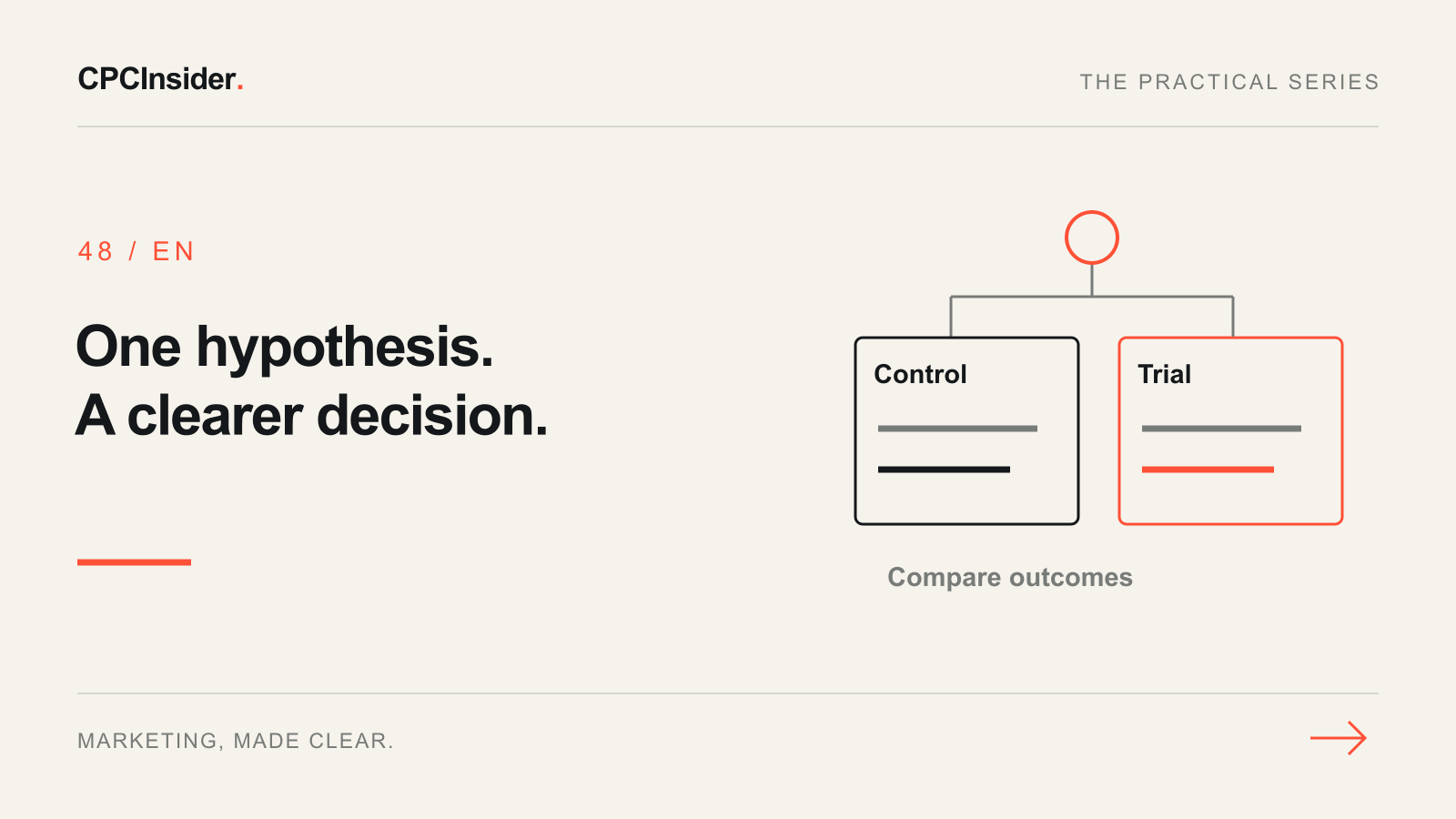
A useful Google Ads experiment answers one business question without changing the rest of the campaign at the same time. More conversions in the trial arm are not enough: the outcomes must mean the same thing, have time to arrive and be worth their cost.
This guide focuses on planning and evaluating a Search campaign test. It complements the CPC strategy guide; it does not prescribe a bidding strategy or promise that every account has enough traffic for a decisive experiment.
1. Write the decision before opening the tool
Use a one-page brief. Define what would make the change worth keeping and what damage would require an early stop. Confirm that the team can afford the test and that the chosen action is measured consistently in both arms.
| Brief field | What to record |
|---|---|
| Question | What uncertainty changes our next decision? |
| Hypothesis | Why should this one change improve the chosen outcome? |
| Treatment | Exact setting or supported variable being tested |
| Primary outcome | Defined conversion or value, plus its cost |
| Guardrails | Lead quality, spending boundary and technical checks |
| Keep stable | Offer, destination, conversion definition and unrelated settings |
| Review plan | Owner, start, evaluation window and decision criteria |
For example: a fictional service company wants to test one supported bidding change while keeping its offer and conversion action stable. The question is whether it can acquire acceptable enquiries more efficiently, not whether a new setting can create more button clicks.
Check primary and secondary conversions before launching. A test cannot rescue a goal that treats an unqualified form submission as a customer.
2. Choose the experiment type that fits the question
Google’s custom-experiment overview separates custom tests from ad variations. For Search creative testing, review the ad-variation option; for a supported campaign-setting test, inspect the relevant experiment workflow. Do not assume every campaign type supports the same controls.
In Experiments, confirm eligibility, the base campaign, the variable, the allocation and dates. Review auto-apply settings explicitly: decide in advance whether a human must approve the final rollout. Save the original configuration and test name before scheduling.
A 50/50 traffic split does not guarantee identical spend or impressions. Avoid diagnosing a broken experiment merely because the two arms spend different amounts. Check actual delivery and eligibility before intervening.
3. Protect the comparison while it runs
Keep a change log for both arms. Do not quietly change the offer, landing page, goals and bidding together, then attribute the result to one variable. If a necessary repair affects the comparison, record it and decide whether the test remains interpretable.
Monitor measurement, policy status and real business handling. A broken form or wrong destination is a technical failure, not a reason to keep spending until the calendar ends. Conversely, a quiet day is not a sufficient reason to declare the trial unsuccessful.
Allow for conversion delay before evaluating recent dates. Choose an evaluation horizon around the sales cycle, expected volume and affordable exposure. No fixed number of days guarantees enough evidence.
4. Separate a better average from a proven improvement
Use Google’s experiment monitoring guide to read the comparison dates, selected metrics, estimated difference and confidence information. Record the confidence level shown; do not silently treat a default setting as 95% confidence.
This is a fictional arithmetic example, not a client result. Suppose a reliable reporting process can connect the same accepted-enquiry definition to each arm:
| Observation | Control | Trial |
|---|---|---|
| Spend | €600 | €660 |
| Accepted enquiries | 20 | 24 |
| Cost per accepted enquiry | €30.00 | €27.50 |
| Calculation | 600 ÷ 20 | 660 ÷ 24 |
The trial’s observed cost is about 8.3% lower. These totals alone do not establish statistical significance, causality or future performance. If CRM qualification cannot be reliably attributed to the arms, record that limitation instead of manufacturing a split.
A confidence interval that includes no improvement can leave a commercially interesting result uncertain. A statistically detectable platform change can also fail your business guardrail. Review both questions before deciding.
5. Treat low volume as a design constraint
More time can help, but it cannot guarantee a useful conclusion. Consider a higher-volume eligible campaign or a larger meaningful hypothesis within the agreed spending boundary. Never broaden to irrelevant traffic just to produce a significant result.
Google’s Campaign Guidance documentation describes experiment-power estimates for supported Performance Max and Search broad-match tests. That feature is not available for every experiment, and a power estimate is not a promise of uplift. Where unavailable, record the limitation rather than inventing a score.
Do not stop on the first favorable day. Use the decision rule agreed before launch and distinguish technical stop conditions from performance review. If the outcome remains inconclusive, keeping the control and documenting what you learned is a valid decision.
Your final decision note
Record the actual dates, arm definitions, matured outcomes, spend, qualification checks, uncertainty and important changes during the run. Choose apply, retain control, extend within the agreed limit, or redesign. State why, who approves and when to verify the result after any rollout.
CPCInsider co-founder Arturs Rubins previously worked at Google. Our paid-media management service combines that experience with commercial measurement; it does not imply Google endorsement or guaranteed results. Book a free 30-minute founder-led growth review and receive a short written plan with three priorities. There is no obligation to hire CPCInsider; implementation scope is agreed separately.
About the author
Free founder-led growth review
Are your ads attracting the right customers?
In a focused 30-minute conversation, we review your advertising, website and sales follow-up together. Afterwards, you receive a short written action plan you can use with your own team or with ours.
Your biggest growth gaps
See where your ads, website or follow-up may be losing potential customers.
Your next 3 priorities
Get a ranked action list with the reason for each recommendation and what to check next.
A practical starting plan
Leave with clear next steps for your team, plus our recommendation if you want help implementing them.
Continue reading
Google Ads conversion delay: when should you judge CPA and ROAS?
Is your Google Ads CPA really too high? Check conversion delay, compare equally mature periods and use a worked example before changing bids or budgets.
Primary vs secondary conversions in Google Ads: what should guide bidding?
Choose primary and secondary Google Ads conversions, check campaign goals and avoid duplicate signals. Follow practical GA4 import and verification steps.
How to create a CPC strategy: 7 steps from clicks to customers
Set click-cost expectations from customer economics, choose a bidding approach that fits your data and evaluate the outcomes beyond the first click.