Measurement
Email deliverability test: accepted, authenticated or actually in the inbox?
Run a controlled email deliverability test: inspect bounces and authentication, check authorised seed inboxes and record what each result can prove.
Vladlens Kecko · · 4 min read
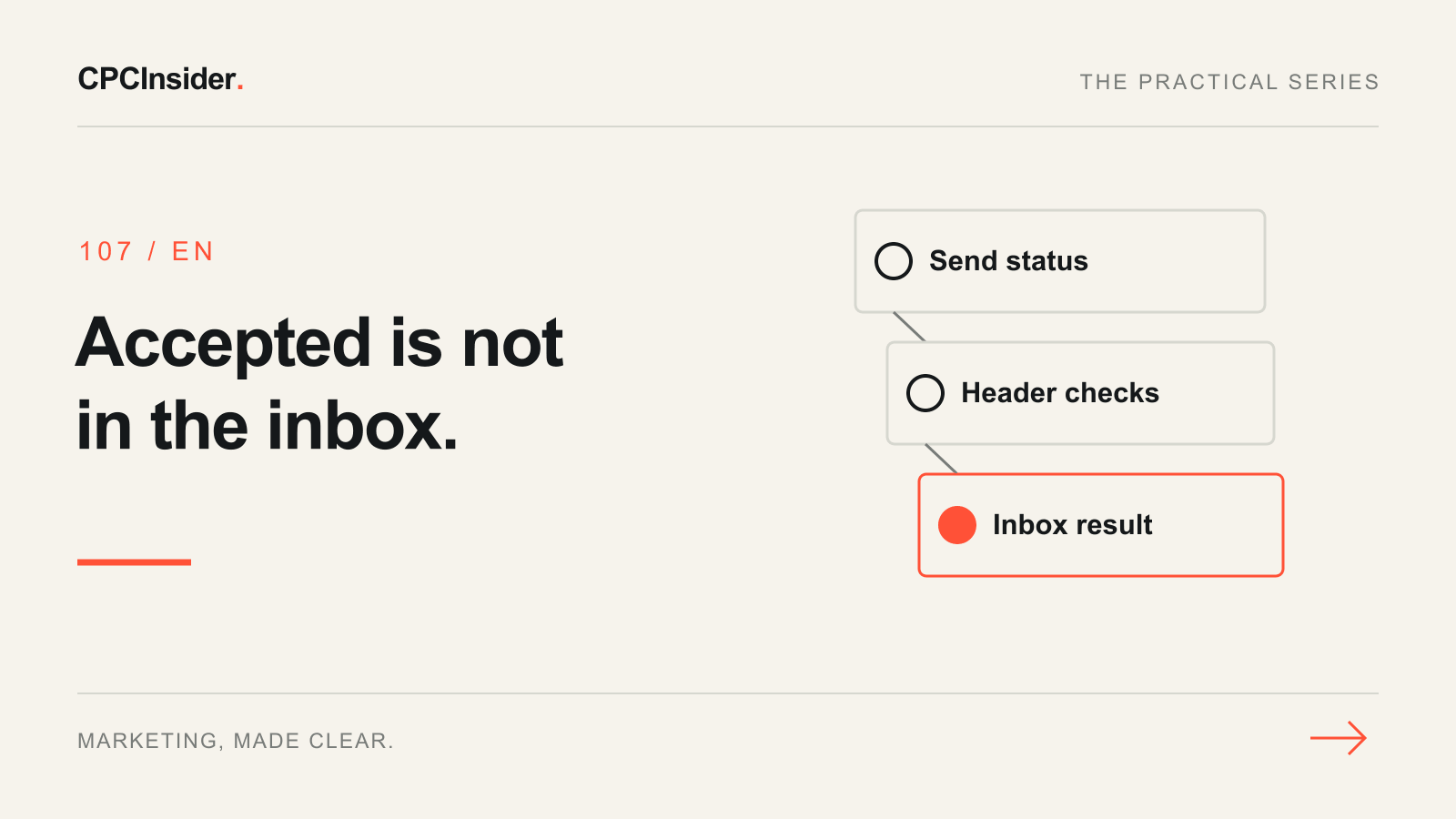
Your email platform says “delivered”, but a customer says nothing arrived. Start with that recipient’s status and the message timestamp in your sending platform. Was it accepted, deferred, bounced or suppressed? Then ask the recipient to check spam and other folders. A delivery status alone does not tell you which folder received the message.
This test investigates the delivery path. Use the broader email preflight checklist for the campaign’s offer, audience and links. Keep transactional and marketing streams identifiable rather than mixing their results into one verdict.
Define a small, authorised test
Use mailboxes you control or recipients who agreed to participate. Include the providers relevant to your audience. Record the sender domain, sending service, stream, template version and time. Send the normal production template through its normal route; a plain test email from another tool does not validate that route.
Preserve the result for each mailbox: accepted status, bounce response if present, folder, authentication result and observation time. A small seed test can expose a problem. It cannot establish an inbox-placement percentage for the whole mailing list.
Inspect authentication at the receiving end
For Gmail in a computer browser, open the message and use the More menu beside Reply, then Show original. Google’s header instructions show the route. Inspect SPF, DKIM and DMARC results, including which domain each result covers. A passing SPF result for an unrelated return-path domain does not by itself establish DMARC alignment with the visible From domain.
Follow your sending provider’s exact DNS instructions and involve the domain administrator before changing records. For mail to personal Gmail accounts, Google’s sender guidelines distinguish requirements for all senders from the additional bulk-sender requirements. Do not apply a bulk-only requirement as though it applied to every sender.
Use the result to choose the next check
| Observation | What to check next |
|---|---|
| Hard bounce | Read the response; correct an invalid address or escalate the stated rejection |
| Deferred message | Inspect the provider’s reason and retry behaviour; check later status |
| SPF, DKIM or DMARC failure | Check the authorised sending route, signing and relevant DNS settings |
| Authentication passes, message in spam | Review complaint signals, recipient expectations, list quality and provider guidance |
| Message accepted but not found | Ask the mailbox owner to inspect rules, forwarding, quarantine and folders |
| One provider differs from the others | Investigate that provider and route before changing everything |
Authentication helps establish sender identity; it does not guarantee inbox placement. Open rates are also a weak substitute for this test because privacy features and image loading affect them.
Retest one change and keep the evidence
Record the exact correction, who made it and when it became effective. Repeat the same route and template to the same authorised seed set. If a new route or template is introduced, label that test separately. Avoid declaring the issue fixed solely because one mailbox received one message.
Before closing, confirm that bounces have a reason, authentication was checked at receipt, folder outcomes are recorded and unresolved cases have an owner. Keep full headers private: they can contain addresses and technical identifiers. Use redacted evidence when sharing findings outside the responsible team.
For ongoing reporting, add this diagnostic to your weekly marketing scorecard as an issue with an owner, rather than another unexplained delivery percentage.
Do not remove an unsubscribe or complaint suppression to make a test pass. Test with authorised addresses and resolve the documented sending restriction through the responsible owner.
Get help tracing the delivery gap
Book a free 30-minute founder-led growth review. We will review the customer journey and measurement gaps, then send a short written three-priority action plan. There is no obligation to hire CPCInsider; implementation is agreed separately.
About the author
Free founder-led growth review
Know where to focus your next marketing investment.
In a focused 30-minute conversation, we review your advertising, website and sales follow-up together. Afterwards, you receive a short written action plan you can use with your own team or with ours.
Your biggest growth gaps
See where your ads, website or follow-up may be losing potential customers.
Your next 3 priorities
Get a ranked action list with the reason for each recommendation and what to check next.
A practical starting plan
Leave with clear next steps for your team, plus our recommendation if you want help implementing them.
Continue reading
Email marketing: a pre-send checklist for one useful campaign
Check recipients, sender setup, message, landing page and follow-up before sending. Includes a campaign worksheet and a fictional reporting example.
Email marketing tools: a test plan before you switch
Compare email marketing tools using one workflow, a suppression test, sender authentication and an export check before switching platforms.
How to build a weekly marketing scorecard for your team
Create a weekly marketing report with defined KPIs, owners and next actions. Use lead-generation and ecommerce examples to turn numbers into decisions.