Growth Strategy
Customer service: stop losing requests between people
Trace one unresolved customer request from receipt to resolution. Set an owner, confirm handoffs and give the customer a useful next update without inventing deadlines.
Vladlens Kecko · · 4 min read
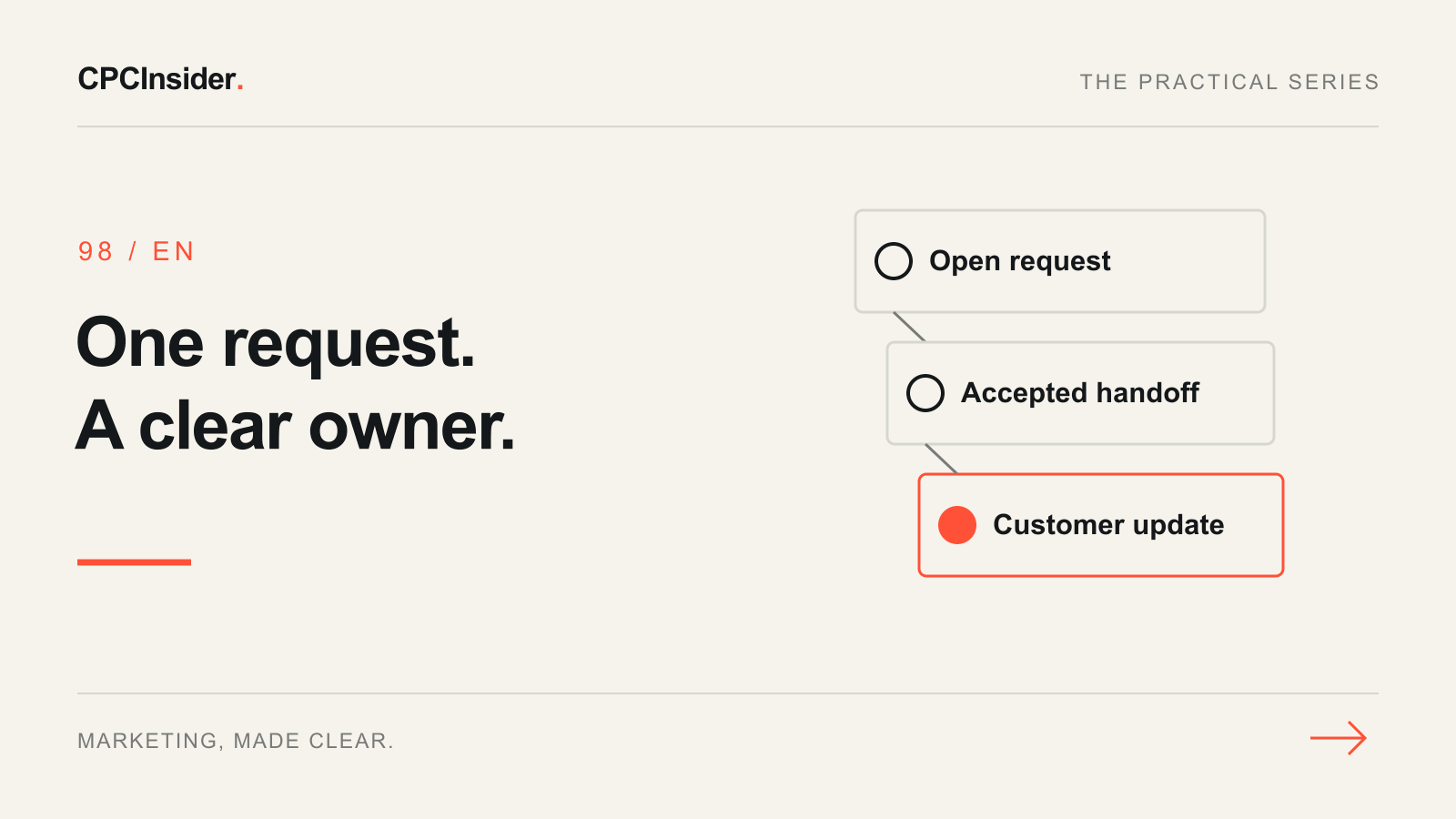
The customer has explained the problem twice, and nobody can say who is handling it. Open one unresolved request. Find its current owner, the next action and the update promised to the customer. A missing field tells you where to start.
Customer service helps people resolve questions and problems around the product or service they use. This guide focuses on the practical handoff between people. It is separate from measuring satisfaction or calculating retention: an answer in a survey does not itself resolve a request.
1. Keep one usable request record
Locate the original message, the affected order or service, the customer's requested outcome and the latest reply. Link related records rather than asking the customer to repeat information the team already holds. Use only information the team is authorised to access.
A CRM ticket is one way to organise the work. HubSpot's record-creation guidance describes properties, record associations and ticket status. Available tools and features vary; the worksheet below also works in an access-controlled shared register. A new software subscription is not the first repair for an unassigned request.
2. Separate responsibility from status
Write down who is responsible for the next action. A department name or a status of “open” does not identify a person who can move the request forward. Arrange backup ownership when the named person is unavailable.
| Field | What to record | If it is missing |
|---|---|---|
| Request reference | Internal ID and original message | Find or create one linked record |
| Customer need | What remains unresolved | Clarify the specific issue |
| Owner | Person responsible for moving it forward | Assign and confirm responsibility |
| Next action | Task, dependency and due point | Agree a feasible action |
| Next update | Who will contact the customer and when | Agree and communicate the update |
| Resolution evidence | What was done and what remains | Review before closing |
Choose response commitments from real capacity and the actual service agreement. Do not invent a universal response-time benchmark or promise an outcome another team has not accepted.
3. Make a handoff an accepted action
When another person must act, transfer the issue summary, work already attempted, relevant records and the exact task. Ask the receiving owner to acknowledge responsibility. A forwarded email shows that a message was sent; it does not show that someone accepted the work.
Keep the current owner responsible for coordination until the receiving owner accepts. Record who will update the customer during the transfer. If acceptance is missing, escalate through the agreed internal route rather than silently leaving the request between teams.
4. Give an update even when the answer is pending
Tell the customer what has been checked, what is still waiting and when they should expect the next update. Explain a changed commitment before it passes where possible. Avoid describing an internal status as if it were a solution.
Before closing, record the action taken and whether the requested outcome is resolved, awaiting customer confirmation or still disputed. Do not mark the customer satisfied solely because the ticket is closed. The separate satisfaction-survey checklist covers feedback after a defined interaction.
If the customer stops replying, follow the actual closure policy and record that reason. Silence is not confirmation that the problem was solved.
5. Review repeated causes without overstating the result
Group recurring reasons from the underlying records. Distinguish a delivery problem from unclear instructions or a missed follow-up. Assign one process change and check whether the same issue recurs under a consistent classification. Fewer reopened records do not by themselves prove higher retention; closure rules and case mix may have changed.
Keep a weekly list of unowned requests, overdue updates, unaccepted handoffs and unresolved repeat issues. Use the customer journey map to locate the responsible stage. Our Business Growth service helps connect these operating decisions. Request a free 30-minute founder-led growth review for a short written plan with three priorities and no obligation to hire CPCInsider.
About the author
Free founder-led growth review
Know where to focus your next marketing investment.
In a focused 30-minute conversation, we review your advertising, website and sales follow-up together. Afterwards, you receive a short written action plan you can use with your own team or with ours.
Your biggest growth gaps
See where your ads, website or follow-up may be losing potential customers.
Your next 3 priorities
Get a ranked action list with the reason for each recommendation and what to check next.
A practical starting plan
Leave with clear next steps for your team, plus our recommendation if you want help implementing them.
Continue reading
Customer satisfaction survey: turn one recent experience into a practical fix
Design a short survey about one customer interaction, test the recipient rules and assign a follow-up owner. Includes a worksheet and reporting checks.
Customer journey mapping: turn buying friction into one useful test
Map one customer, one buying situation and the evidence behind each step. Includes a B2B example, ownership checklist and a focused improvement test.
Customer retention rate: turn the number into one practical improvement
Use customer retention rate to identify where customers leave, investigate the reasons and plan one measurable improvement with clear ownership.